Reference
Sandpaper grit chart
All 25 standard grits, with the CAMI and FEPA numbers side by side and the average particle size in microns — the only figure that means the same thing on both scales.
The full chart
Microns are average particle diameter. CAMI and FEPA numbers are close but not equal — see the conversion page for why.
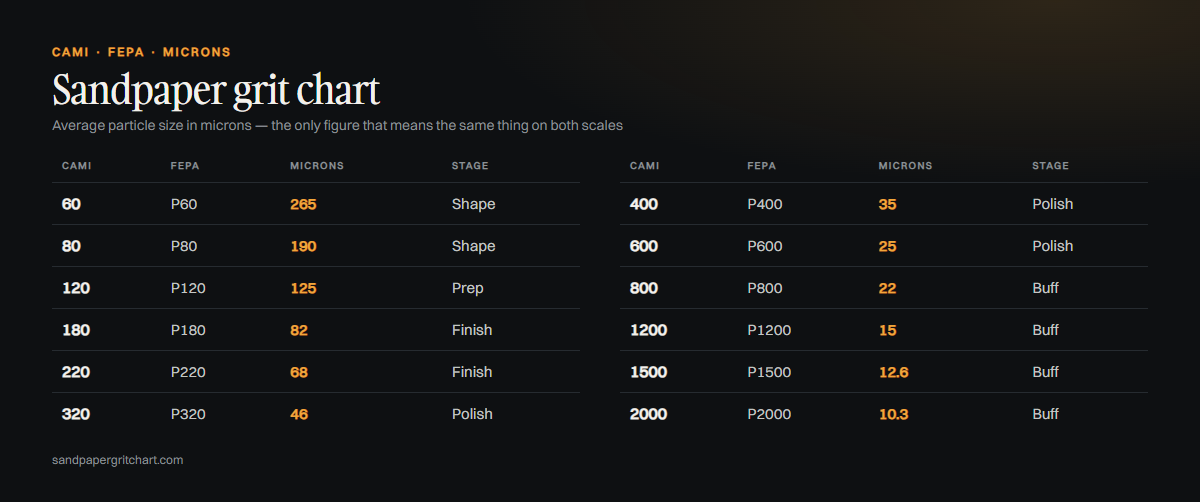
| Grit | FEPA | Microns | Stage | Typical use |
|---|---|---|---|---|
| 24 | P24 | 764 | Strip | Heavy material removal, stripping paint from decking, sanding off old finish |
| 30 | P30 | 642 | Strip | Rough shaping, removing planer marks on thick stock |
| 36 | P36 | 538 | Strip | Shaping rough timber, floor sanding first pass, removing old varnish |
| 40 | P40 | 425 | Strip | Fast stock removal, levelling a rough board |
| 50 | P50 | 348 | Shape | Removing saw marks before finer work |
| 60 | P60 | 265 | Shape | Stripping finish, flattening timber, first grit for most furniture repairs |
| 80 | P80 | 190 | Shape | General prep, removing rust, sanding drywall, erasing 60-grit scratches |
| 100 | P100 | 150 | Prep | Smoothing bare wood, preparing for paint, wet-sanding primer |
| 120 | P120 | 125 | Prep | Smoothing bare wood, first drywall pass, between coats of paint |
| 150 | P150 | 100 | Prep | Finish prep on bare wood, removing 120-grit scratches |
| 180 | P180 | 82 | Finish | Final pass before staining or sealing, scuffing between varnish coats |
| 220 | P220 | 68 | Finish | The last grit before most finishes. Scuffing between coats, fine woodwork |
| 240 | P240 | 58 | Finish | Between coats of lacquer, fine surface prep |
| 280 | P280 | 52 | Finish | Very fine prep, cutting back lacquer |
| 320 | P320 | 46 | Polish | Between finish coats, wet-sanding primer, removing 220-grit scratch |
| 360 | P360 | 40 | Polish | Automotive primer sanding, very fine wood prep |
| 400 | P400 | 35 | Polish | Wet-sanding between clear coats, levelling dust nibs |
| 500 | P500 | 30 | Polish | Fine coat sanding before final gloss |
| 600 | P600 | 25 | Polish | Wet-sanding clear coat, lacquer flattening, near-mirror prep |
| 800 | P800 | 22 | Buff | Pre-polish on automotive clear, fine metal finishing |
| 1000 | P1000 | 18 | Buff | Polishing, removing 800-grit scratch before compound |
| 1200 | P1200 | 15 | Buff | High-gloss prep on metal, paint and plastic |
| 1500 | P1500 | 12.6 | Buff | Buffing and first stage of mirror polishing |
| 2000 | P2000 | 10.3 | Buff | Mirror finish on metal, final clear-coat pass |
| 2500 | P2500 | 8.4 | Buff | Final polish before machine compounding |
How to read this chart
Columns one and two are the same paper under two naming systems. Column three is the physical size of the abrasive particle, which is what actually determines the scratch. Column four groups the grits by what stage of work they belong to: strip, shape, prep, finish, polish and buff.
In practice, six grits do most of the work in a home workshop — 60 for stripping, 80 for shaping, 120 and 180 for prep, 220 as the last step before finish, and 320 or 400 for between coats. Everything above 600 is polishing, and everything below 60 is for material removal where the surface will be sanded again anyway.
The micron column is the honest one. A 220 in one brand and a 220 in another can differ by ten microns, because the standard sets a size range rather than an exact figure. If a finish is failing and you cannot work out why, compare microns rather than grit numbers — that is usually where the mismatch is.
Which grits to actually keep on the shelf
Five grits cover almost everything: 60 for stripping, 80 for shaping, 120 and 180 for prep, 220 as the last step before finish. Add 320 and 400 if you finish furniture, and 800 through 2500 only if you polish paint or metal.
Buying the gaps — 100, 150, 240 — is optional. They exist because the range between the common grits is wide enough that some work benefits from an intermediate step, but a home workshop rarely notices the difference. Spend the money on more paper in the grits you actually wear out.
Paper is consumable. A sheet that has gone shiny and stopped cutting is glazed: the abrasive has worn flat and it will burnish the surface rather than sand it. Change it rather than pressing harder — pressure ruins the scratch pattern and overheats the workpiece.
Questions people ask
How many sandpaper grits are there?
The standard CAMI range runs from 24 to 2500. Above 2500 are lapping films and polishing compounds measured only in microns. Most of the trade lives between 60 and 400.
What is the coarsest sandpaper?
24 grit, at roughly 764 microns. It is for stripping and floor sanding, not for wood you intend to finish — it leaves gouges a finer grit cannot remove.
What grit is 1000 in microns?
About 18 microns. That is polishing territory: removing the scratch from 800 grit before a compound.
Which grit removes the most material?
The lowest number. 40 grit cuts faster than 80, which cuts faster than 220 — but coarse grit also leaves damage that has to be sanded out, so it is not automatically faster overall.